


At Power Passion and Purpose, healing does not follow a single path. It can happen through conversation, connection, education and sometimes through something as simple as placing a seed into the soil and watching it grow.
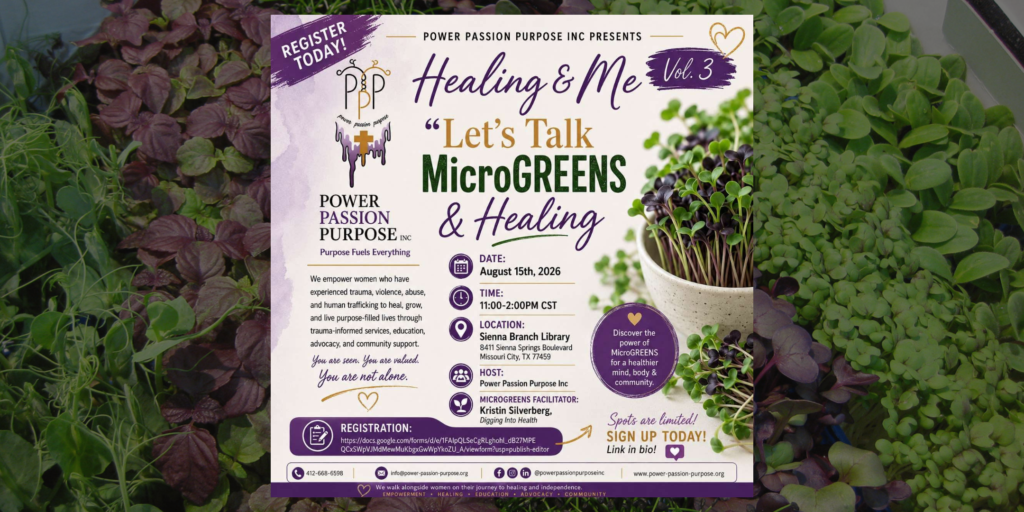
On August 15, Power Passion and Purpose Inc. will present Healing & Me, Vol. 3: “Let’s Talk Microgreens & Healing,” an educational experience exploring how gardening and microgreens can support healthier minds, bodies and communities.
Event details
Date: Saturday, August 15, 2026
Time: 11 a.m.–2 p.m. CST
Location: Sienna Branch Library
Address: 8411 Sienna Springs Boulevard, Missouri City, TX 77459
Host: Power Passion and Purpose Inc.
Microgreens facilitator: Kristin Silverberg of Digging Into Health
Space is limited. Register for the event.
Healing takes root
The idea of incorporating gardening into 3P’s trauma-informed programming grew from a meaningful connection with Kristin Silverberg, whom I met at an event earlier this year. Kristin is a survivor and overcomer, a registered nurse and someone who understands the therapeutic value of gardening through both personal and professional experience.
During her own healing journey, Kristin used gardening as a therapeutic outlet. She later introduced gardening to a patient she was working with, giving him another way to engage, find purpose and experience the satisfaction of nurturing something over time.
Her story resonated deeply with me because plants and gardening have also played a meaningful role in my own healing process.
Gardening requires patience, consistency and hope. A seed may not look like much when it is first planted, but with the right environment and continued care, it has the capacity to become something strong and life-giving.
More than growing food
For the women served by 3P’s, gardening offers much more than an opportunity to grow food. It introduces them to an activity that may support their healing and recovery while creating opportunities to strengthen bonds with their children.
Gardening can also help women connect with one another and begin building the sense of community they may need throughout their long-term journeys.
What the garden can nurture
Healing and purpose: Caring for something over time creates a restorative rhythm and a visible sense of progress.
Family connection: Gardening gives mothers and children an intentional activity they can learn and enjoy together.
Community: Shared growing spaces create opportunities for women to learn, participate and build supportive relationships.


Nutrition within reach
During the August 15 event, Kristin will share information about the health and nutritional benefits of growing microgreens.
These nutrient-rich greens can be produced at a relatively low cost, require limited space and provide a high-yield source of nutrition. This makes them a practical option for women and families who want to incorporate more fresh, nutritious foods into their daily lives without needing a large garden or expensive equipment.
Kristin will also provide information about community gardens where participants can continue learning, take part in gardening activities and connect with other people in their communities.
Trauma-informed care in practice
The experience reflects the heart of trauma-informed care. Healing is not limited to what happens in a traditional counseling room. It can also happen while working with the soil, learning a new skill, preparing healthy food, spending intentional time with a child or becoming part of a supportive community.
The same potential found in a seed can be found in the people and families 3P’s serves. Introducing gardening is another layer of the trauma-informed care 3P’s brings to the community. It demonstrates our commitment to thinking beyond conventional approaches and creating safe spaces where women can explore different tools for healing, recovery, family connection and long-term well-being.
At 3P’s, we understand that healing can take many forms. Sometimes, it begins with a conversation. Sometimes, it begins with a supportive community. And sometimes, it begins with a seed.
Join Power Passion and Purpose Inc. for Healing & Me, Vol. 3: “Let’s Talk Microgreens & Healing” on Saturday, August 15, from 11 a.m. to 2 p.m. at the Sienna Branch Library in Missouri City.
Register now to reserve your spot.

