
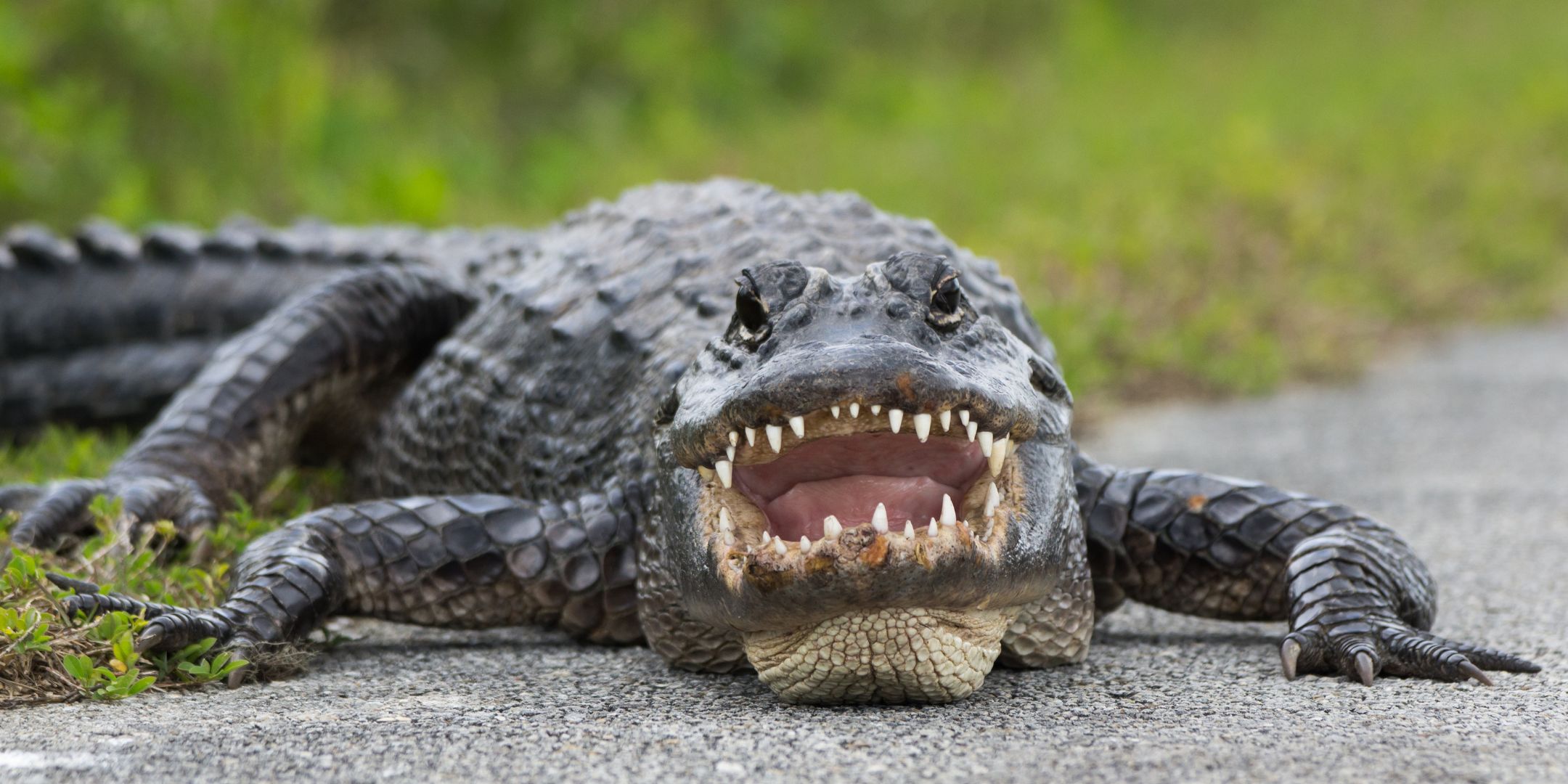

Sightings are up across the area right now – here’s why it’s happening and how to keep your family and pets safe.
If your neighbor’s Facebook post this week included a video of a massive alligator sunning itself on a golf course, you didn’t imagine it – and you’re not alone.
Alligator sightings are surging across the Houston area right now, from Fort Bend County to Harris County to the shores of Galveston Island. A resident in Sienna recently described the gator near her home as the biggest she’s ever seen – spotted near the community’s golf course, which sits close to homes, canals, and an elementary school. Harris County deputies were called out this week to help a younger alligator safely cross West Lake Houston Parkway. Encounters that used to feel like an occasional surprise are starting to feel like a weekly news story.
So what’s going on? Is Houston actually seeing more alligators? And what should you do if you come face to face with one?
It’s Mating Season – and That Changes Everything
The short answer is: it’s that time of year.
According to Texas Parks and Wildlife, alligators spend most of the winter largely dormant. They re-emerge in March and hit peak activity between March 1 and May 30 – the heart of mating and nesting season. During this window, male alligators roam widely in search of mates, sometimes covering surprising distances and turning up in places they’re not typically seen the rest of the year. Younger alligators in the four-to-five-foot range also move more during this period, searching for new territory as they mature.
That explains why you might spot a gator on a golf course fairway, crossing a neighborhood road, or sitting on the bank of a retention pond that didn’t seem to have any wildlife in it last month. They haven’t moved into the area permanently – they’re on the move, and your neighborhood happens to be in the way.
Wildlife experts are clear that this is normal, seasonal behavior. The animals aren’t acting aggressively or unusually. They’re just doing what alligators do in spring – and in a city like Houston, that’s increasingly hard to miss.
Why Houston Specifically?
Houston isn’t just alligator territory – it’s prime alligator territory.
The region is largely marshland, bayous, and wetlands, which is exactly the habitat American alligators prefer. Texas is estimated to be home to between 400,000 and 500,000 alligators, and a significant concentration of them live in Southeast Texas. Alligators are present in 120 of Texas’s 254 counties and Harris County is squarely on that list.
Here’s the wrinkle that makes Houston different from rural alligator habitat: the city has grown directly into gator country. Subdivisions, retention ponds, golf course water hazards, neighborhood lakes, and drainage channels have essentially created new alligator habitat in the middle of residential areas. When a developer builds a master-planned community on what was previously wetland, the alligators don’t disappear – they adapt.
As Texas Parks and Wildlife staff at Brazos Bend State Park put it, the increase in encounters isn’t necessarily because there are more gators. It’s because more people are living alongside them. Communities like Sienna, which residents openly acknowledge was built on swampland, are simply part of the alligators’ world now.
What to Do If You See One
This is where a lot of people get it wrong, so let’s be direct.
Keep your distance. The rule of thumb from Texas Parks and Wildlife is a minimum of 30 feet. If an alligator hisses at you, you’re already too close – back away slowly.
Do not run in a zig-zag pattern. This is one of the most persistent myths about alligator encounters, and it’s false. If an alligator is coming toward you on land, run away in a straight line as fast as you can and get inside a vehicle or building. Alligators can move at speeds up to 35 miles per hour in short bursts – but they tire quickly and rarely pursue over distance.
Do not approach or attempt to move it yourself. Even a small alligator can be dangerous. Call the professionals.
Do not feed alligators – ever. This is both illegal and genuinely dangerous. When alligators associate humans with food, they lose their natural wariness and begin approaching people. That almost always ends badly for the alligator – it gets labeled a nuisance and removed or euthanized. Feeding alligators in state parks is a Class C offense with fines up to $500, and the same principle applies anywhere. Even tossing fish scraps into the water near an alligator counts.
If an alligator is blocking access to your home, appears aggressive, or is in a location that poses an immediate public safety risk, call Texas Parks and Wildlife Department Law Enforcement Communications at 512-389-4848. Removal is considered a last resort and is handled by licensed nuisance hunters – not something residents should attempt on their own.
One more important note: shooting an alligator is only legally justified in immediate self-defense. Not after the fact.
Protecting Your Pets
Pets – especially small dogs and cats – are at genuine risk near any body of water in the Houston area during gator season, and honestly year-round.
The advice here is simple but non-negotiable: keep pets leashed near any water source. Don’t let dogs wade in or drink from ponds, bayous, canals, or any body of water where you can’t see the bottom. Alligators are ambush predators and can move from the water’s edge faster than most people expect. Dawn and dusk are peak activity times, so exercise extra caution during those hours.
If you live in a community with retention ponds or lakes — which describes a significant portion of Katy, Sugar Land, Cypress, Pearland, and the surrounding suburbs — treat those water features as potential gator habitat during spring and summer months. Because they are.
Who Should Be Most Concerned?
Families with young children near any body of water should take alligator presence seriously. Children’s unpredictable movement and smaller size make them more vulnerable. Several local school districts in areas like Sienna already send notifications home about alligator safety during this time of year – if your district does the same, don’t scroll past it.
Pet owners, as mentioned, especially those with small breeds, are in the highest-risk group during gator season. Keep that leash on and stay back from the water’s edge.
Anglers and kayakers on Houston-area bayous, lakes, and waterways should be aware that alligators are present and active right now. Don’t assume a calm-looking shoreline is clear.
Residents of newer master-planned communities built on former wetland areas – Sienna, Cross Creek Ranch, Bridgeland, and similar developments across Fort Bend and Harris County – are seeing this firsthand right now. Living alongside alligators isn’t unusual in these communities; it’s just part of the seasonal rhythm.
The Bigger Picture
The American alligator is a protected species in Texas, managed through regulated hunting, egg collection programs, and nuisance control. They are also, whether we like it or not, a fundamental part of the ecosystem that Houston was built on. They control invasive species, support bird populations, and maintain the health of wetland habitats that the region depends on.
They are not going away. And as Houston continues to expand into areas that were once theirs, encounters will only become more common – not because the gators are getting bolder, but because we keep showing up in their backyard.
Knowing how to live alongside them safely isn’t just good advice for right now. It’s a permanent skill set for anyone living in Southeast Texas.
Houston City Beat keeps you informed on what’s happening in our city – including the things that are literally crossing your path. Have a local story or tip? email us at info@houstoncitybeat.com