


You tend to believe a century of history is permanent, until a single morning proves how fragile it really is.

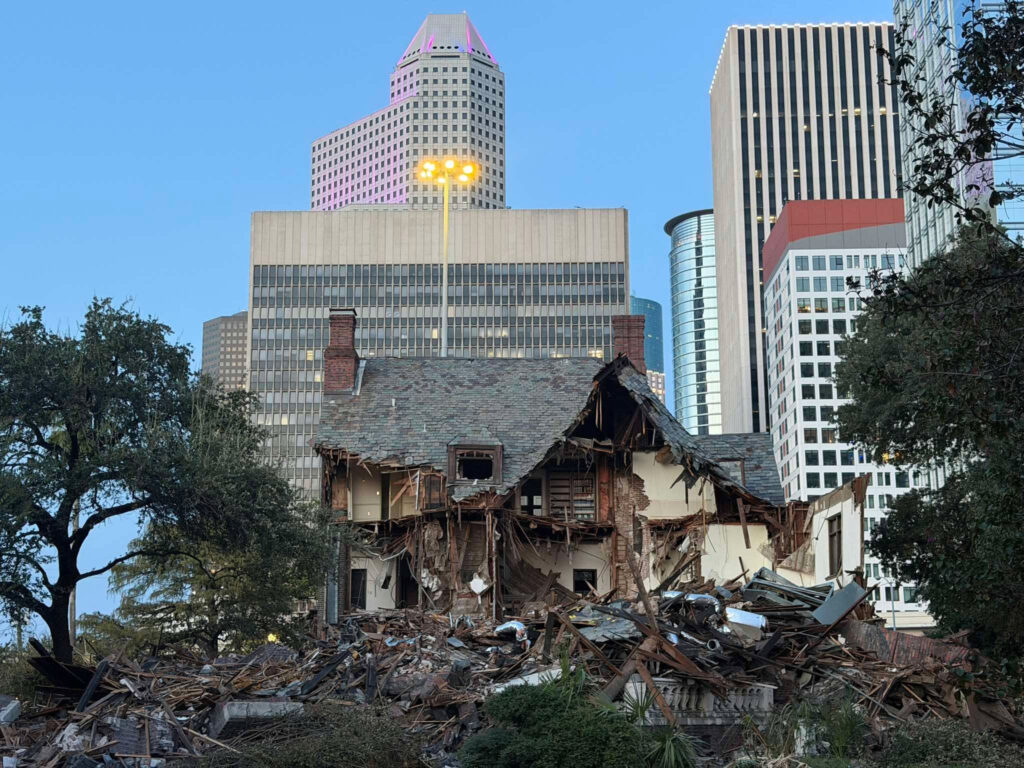
For Houston’s Kirby Mansion, that morning came on Friday, October 30, 2026. Heavy machinery tore into the historic estate, destroying substantial portions of the building before city inspectors ordered work to stop over a missing demolition permit.
By Monday morning, November 2, the remaining structure had been torn down. A property whose history stretched back to 1894 had become a demolition site, with a proposed gas station and convenience store development now part of the conversation about its future.
The mansion’s final chapter was written by demolition crews, not a hurricane. And for the Houstonians who had worked to save it, the loss carries a difficult question: Why does protecting our history so often become a race against the wrecking ball?
A city’s history, exposed to the sky
Among the most unsettling details of the demolition were books still sitting on shelves inside the damaged building. With walls torn away, the shelves and their contents remained visible.
It was a small, ordinary detail amid an enormous loss. It made the building feel less like a vacant property on a redevelopment map and more like a place where life had continued, room by room, across generations.
The loss extended beyond the building itself. Furniture, artwork and historic books remained inside and were destroyed along with architectural elements that gave the mansion its character. The demolition erased both the structure and pieces of the history it held.
City officials told the Houston Chronicle that demolition began without the required permit. Inspectors ordered work halted, but the intervention came after significant damage.
Chron later reported that the new owner, OB Texas Properties LLC, secured the demolition permit Friday afternoon. Crews completed the teardown Monday morning.
The stop-work order interrupted the demolition. It did not save the mansion.
More than a grand old house
The property’s story began in 1894, just 58 years after Houston’s founding. Businessman J.S. Price built the original house, which John Henry Kirby purchased in 1896.
The familiar 36-room Tudor Revival mansion took shape through an extensive 1926 remodeling by architect James Ruskin Bailey. That distinction matters: the estate’s roots reached into the nineteenth century, while its later architecture reflected another chapter in Houston’s growth.
According to Preservation Houston, the house was sold in 1947 and served as headquarters for the Houston-Harris County Red Cross for the next 30 years. It later became office space.
The mansion also served as headquarters for preparations for the 1990 Houston Economic Summit. Archived presidential remarks document President George H.W. Bush speaking in its lobby that May.
As one of the remaining grand homes of the former South End neighborhood, it offered a connection to a residential Houston that had largely disappeared around it.
Its changing uses showed that historic buildings can adapt. The mansion had already lived several lives.
The Houstonians working to save what remains
Houston is often celebrated for building, expanding and reinventing itself. The harder conversation is about what disappears along the way, and whether demolition is treated too readily as the starting point for something new.
There are Houstonians working hard to change that.
Preservationists, historians, neighborhood residents and advocates devote their time to researching buildings, sharing their stories and making the case for restoration and reuse. Their work asks the city to recognize value that cannot be measured only by a property’s next commercial use.
At the Kirby Mansion, that effort was visible. FOX 26 reported that neighbors, preservation advocates and Kirby descendants gathered outside the property Sunday. Preservation Houston had sought conversations about retaining the building, while Mister McKinney argued that development and preservation could coexist.
That is an important part of this story. People cared. People spoke up. People tried to find another path.
Preservation work also has a record of success. Preservation Houston’s Good Brick Awards archive documents decades of restoration and adaptive reuse throughout the city. The Kirby Mansion itself received recognition for restoration and reuse in 1979.
Those successes make this loss more painful, but they also show that demolition is not the only way forward.
What is expected to come next
A state project filing identifies a development called “Braketime Smith Road” at 530 Pierce Street, within the mansion’s block. It describes a $2 million, one-story commercial building that includes a convenience store.
Local reporting points to a proposed gas station and convenience store. The final development and its approval status remain separate from the now-completed demolition.
For those mourning the mansion, the prospect raises a larger question about priorities. When a building with more than a century of history is removed, what should the community expect in return? And how much of that history could have remained part of the next chapter?
Get involved in saving Houston’s history
The loss of the Kirby Mansion does not have to be the end of the conversation. Houstonians who want to volunteer, connect with fellow preservation supporters and learn how to get involved can visit SaveHoustonHistory.com.
Whether you are a longtime resident or new to the city, your interest in its historic places matters. Helping share their stories and supporting preservation efforts can bring attention to threatened buildings before demolition begins.
A story worth remembering
Houston City Beat documented this moment with insight from Jason Fuller and Mister McKinney’s Historic Houston. Their willingness to share their knowledge on site helps preserve a record of what stood here and why it mattered.
Their efforts belong to a much larger community of Houstonians determined to keep the city’s history visible.
The Kirby Mansion is gone. The work of protecting other historic places continues, and it needs attention long before the next demolition crew arrives.
At Houston City Beat, we are the storytellers of Houston. That means celebrating what our city is becoming while remembering the places, people and experiences that brought us here.
Is replacing a 132-year piece of Houston’s history with a proposed gas station the price of progress? What should our city do differently before the next historic building is lost?

