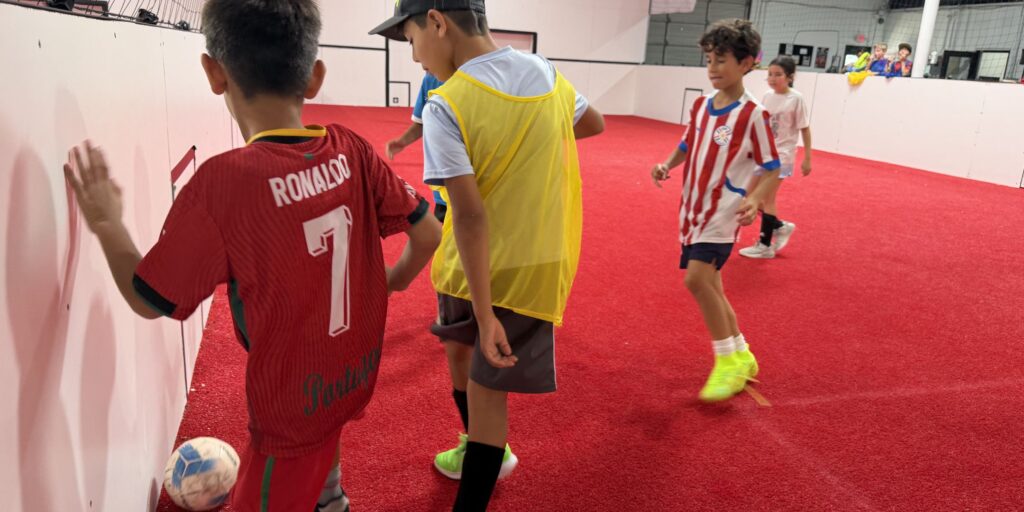
In youth soccer, it’s common to hear parents cheering from the sidelines:
“She’s our defender.”
“He’s the striker.”
“She plays midfield.”
For many young athletes, that position is assigned before they’ve had the opportunity to discover what they’re truly capable of becoming.
Ryan Shumbera, founder of Panther Soccer, believes that approach may be limiting a child’s long-term development.
Rather than assigning children to a single position based on what the team needs today, Shumbera believes young players should experience every aspect of the game while they’re still developing.
“Children are constantly changing,” he explains. “The player who is the tallest and strongest in fifth grade may not be that player at fifteen. If they’ve only learned one position, they may find themselves at a disadvantage later because they never developed the complete set of skills the game requires.”
Instead of early specialization, Panther Soccer encourages players to rotate through every position on the field.
Walk into Panther Soccer and you’ll probably notice something unusual.
Young players aren’t lining up to play the same position every week. One practice they may be defending. The next they’re attacking. Before long they’re learning midfield, creating scoring opportunities, and seeing the game from every angle.
For Panther Soccer founder Ryan Shumbera, that’s entirely by design.
After decades of playing, coaching, and studying youth soccer, Shumbera has come to believe one of the biggest mistakes made in player development happens long before athletes reach high school.
“We tend to put kids into boxes too early,” he says.
A child might be the tallest player on the team in fifth grade, so they become a defender. Another may score a few early goals and suddenly they’re labeled a striker. Before long, those positions become permanent, not because they’re the best fit for the player’s future, but because they’re what the team needs right now.
The problem, according to Shumbera, is that children don’t stop developing.
“The player who is the biggest and strongest at ten years old may look completely different at fifteen,” he explains. “If they’ve only learned one position, they may never develop the complete skill set the game requires.”
That philosophy became one of the driving forces behind Panther Soccer.
Instead of asking where a player fits today, Shumbera asks a different question:
How can we help this child become the best soccer player they can be five years from now?
The answer starts by exposing players to every position on the field.
Learning to defend teaches anticipation and patience.
Playing midfield develops vision and decision-making.
Attacking builds confidence and creativity.
Each position teaches something different, and together those experiences create a player who understands the game instead of simply memorizing a role.
Shumbera remembers one player who wanted nothing more than to stay on defense.
Many coaches would have happily left him there.
Instead, Panther Soccer encouraged him to rotate into attacking positions, even when he wasn’t comfortable doing so.
Years later, that same player became one of the club’s most prolific goal scorers.
It’s the kind of transformation Shumbera believes happens when young athletes are given the freedom to discover abilities they didn’t know they had.
That same philosophy extends beyond positions.
Panther Soccer emphasizes small-sided games and indoor training environments that allow players to spend significantly more time with the ball. More touches mean more decisions. More decisions create more confidence. And confidence often becomes the difference between a child who simply plays soccer and one who truly falls in love with the game.
For Shumbera, youth soccer isn’t just about preparing children for next weekend’s match.
It’s about preparing them for the years ahead.
By focusing on complete player development instead of early specialization, Panther Soccer encourages young athletes to think creatively, solve problems, and embrace challenges both on and off the field.
For parents, that may require rethinking what success looks like during the developmental years.
Instead of asking whether a child has found the “right” position, perhaps the better question is whether they’re continuing to learn, grow, and discover new abilities.
Because while positions may eventually define a player’s role on the field, it’s a well-rounded foundation that gives them the greatest opportunity to succeed when that time comes.
And sometimes, the player a child becomes is someone no one could have predicted at the beginning of the journey.