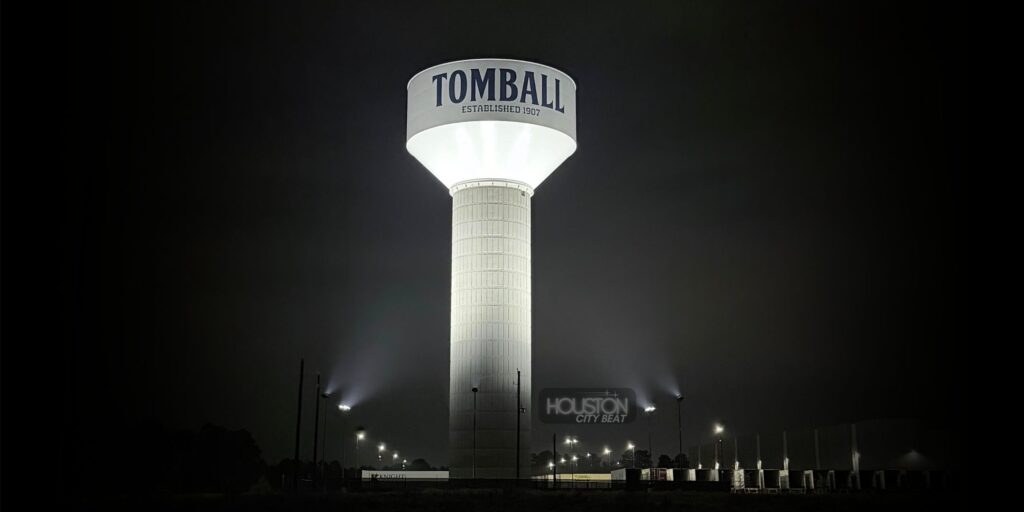


Take a drive through Katy, Sugar Land, Pearland, or Jersey Village and you’ll probably spot a water tower within a few minutes. Taking it a step further, you’ll notice water towers are non-existent in the City of Houston.
At first glance, it seems like a mystery.
After all, Houston is the fourth-largest city in the United States. Shouldn’t it have the most water towers?
Surprisingly, the answer is no.
The reason has everything to do with how the region delivers one of life’s most essential resources.
Houston and Greater Houston Aren’t the Same Water System
While people often refer to everything as “Houston,” the Greater Houston area is actually made up of dozens of independent cities, municipal utility districts (MUDs), water districts, and utility providers.
Communities such as Katy, Sugar Land, Pearland, Bellaire, Jersey Village, Deer Park, Missouri City, Friendswood, and countless master-planned neighborhoods frequently operate their own local water systems.
Many of these systems use elevated water towers as a practical and cost-effective way to maintain water pressure and provide emergency water storage.
The City of Houston, however, operates on an entirely different scale.
Serving millions of residents across hundreds of square miles, Houston relies primarily on massive water treatment plants, ground-level storage reservoirs, high-capacity pumping stations, and an interconnected network of underground water mains rather than a landscape filled with elevated water towers.
That’s why the iconic towers are far more common around the suburbs than they are inside Houston’s urban core.

It’s Not Really About Storing Water
Many people assume water towers exist simply to hold extra water.
While they certainly do store water, that’s only part of the story.
Their greatest purpose is creating water pressure.
By placing water high above the ground, gravity naturally creates pressure throughout the distribution system. Every time someone turns on a kitchen faucet, flushes a toilet, takes a shower, or connects a garden hose, that elevated water helps keep the pressure consistent.
It’s an elegant piece of engineering that has served communities for generations.
Why Not Just Use Pumps?
Modern pumps do much of the heavy lifting, but they work best alongside stored water.
Water towers help smooth out periods of high demand, such as early mornings when thousands of people are showering before work or evenings when entire neighborhoods are cooking dinner, watering lawns, and running dishwashers.
Instead of pumps constantly racing to keep up with sudden spikes in demand, the tower provides a reserve of pressurized water that’s ready when it’s needed.
The result is a more stable and efficient system.

An Important Backup During Emergencies
Water towers also provide an important safety net.
If firefighters need large amounts of water during a fire, the tower helps maintain pressure in nearby hydrants.
If a temporary power outage affects pumping stations, gravity can continue moving water through the system for a period of time while crews restore operations.
That added reliability makes elevated storage an important part of many community water systems.
Why Newer Neighborhoods Sometimes Look Different
As technology has improved, many newer developments have shifted toward large ground-level storage tanks combined with sophisticated pumping systems.
These systems can provide the same reliable service while reducing some construction and maintenance costs.
Even so, elevated water towers remain common throughout Greater Houston because they continue to be an efficient and dependable solution for many independent water providers.
Quiet Landmarks Across Greater Houston
Unlike Houston’s skyline, sports stadiums, or famous bayous, water towers rarely become tourist attractions.
Yet they’ve become recognizable landmarks in communities across the region. They often carry the name of the city they serve, making them symbols of local identity as much as pieces of infrastructure.
So the next time you drive through the suburbs and notice one standing above the trees, remember that it’s doing far more than decorating the skyline.
It’s quietly helping deliver clean water, maintain water pressure, support firefighters during emergencies, and keep an entire community running, one gallon at a time.
And if you don’t see many inside the City of Houston itself, now you know why. The city’s massive, interconnected water system simply relies on a different approach to moving water than many of the communities that surround it.