
Early in my career, I started to realize something that changed how I approached training and therapy altogether.
It wasn’t just about teaching proper form.
A mentor of mine helped me see that nearly everyone has some level of imbalance — whether they feel it or not — and those imbalances affect how the body moves, stabilizes, and produces force.
What I began to understand is that proper form alone only goes so far. You can coach someone into the “right” position, but that doesn’t guarantee the right muscles are actually doing the work.
And that’s where most programs fall short.
Because there is no such thing as a universal exercise.
Every individual brings a different set of adaptations, compensations, and learned movement patterns. The body doesn’t respond the same way from person to person — even if the exercise looks identical on the surface.
That’s why assessment matters.
Because without it, exercise selection becomes guesswork.

The Problem with One-Size-Fits-All Training
One of the biggest issues I’ve seen over the years is this:
Many injuries could have been prevented with proper programming and exercise selection — specific to the individual.
Instead, people follow generalized programs that were never designed for how their body actually moves.
Here’s where the problem starts.
If you don’t understand the range of motion your body can actively control and stabilize, you may either push beyond safe limits or compensate to get there — especially under load, where injury risk increases.

What Assessment Really Means
Because if you can’t safely control a position without resistance, adding load only magnifies the problem.
But it’s not just about range of motion.
Sometimes the issue is that the body doesn’t have access to the positions required to perform an exercise properly in the first place. Yet instead of identifying why, most people simply modify the movement to avoid pain.
Shift the angle.
Adjust the stance.
Work around the problem.
And while that may reduce discomfort in the short term, it often reinforces the underlying issue — or creates a new one.
This is amplified by what I call the “try this workout” culture.
Programs are marketed as if they produce universal results — as if the same inputs will create the same outcomes for everyone.
But they don’t.
Because there is no one-size-fits-all approach to exercise.
Without assessment, it’s all guesswork.
Why It Matters
In a city like Houston, where people are constantly balancing work, stress, and an active lifestyle, it’s easy to fall into generalized training approaches that aren’t built for the individual.
Without proper assessment, progress becomes unpredictable.
People spend months — sometimes years — working hard, only to hit plateaus that don’t make sense. Not because they aren’t putting in the effort, but because the underlying imbalances haven’t been addressed.
When those imbalances are ignored, they don’t disappear.
They get reinforced.
And over time, that leads to stalled progress, inefficient movement, and increased risk of injury.
On the other hand, when assessment is used correctly, it creates direction.
It allows you to build a foundation first — addressing how the body moves before simply adding more load or intensity.
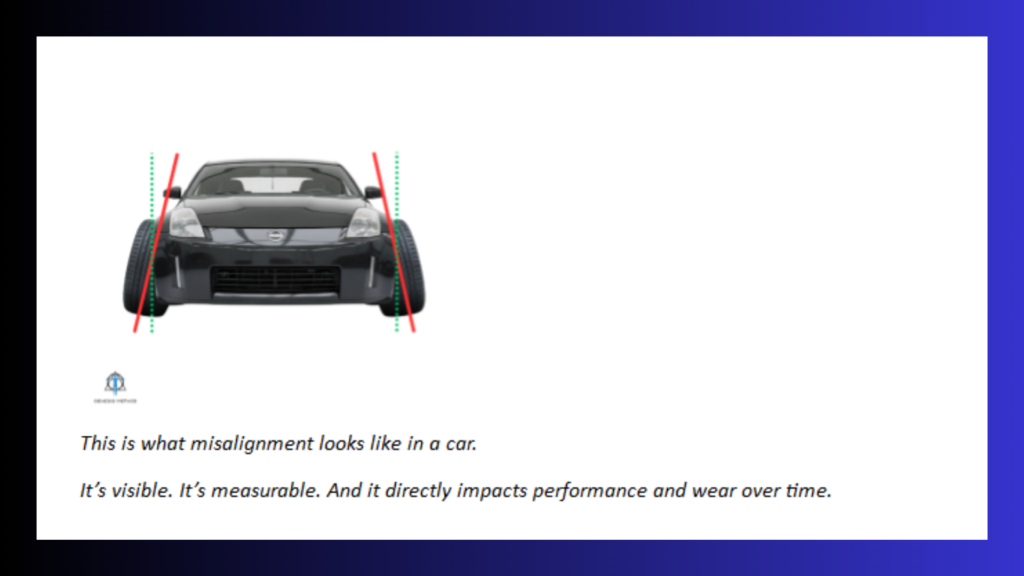
Think of it like a car alignment.
If a car is out of alignment, you don’t start by adding a bigger engine to make it go faster. You correct the alignment first — because if the foundation is off, adding more power only makes the problem worse.
This is what misalignment looks like in a car.
It’s visible. It’s measurable. And it directly impacts performance and wear over time.
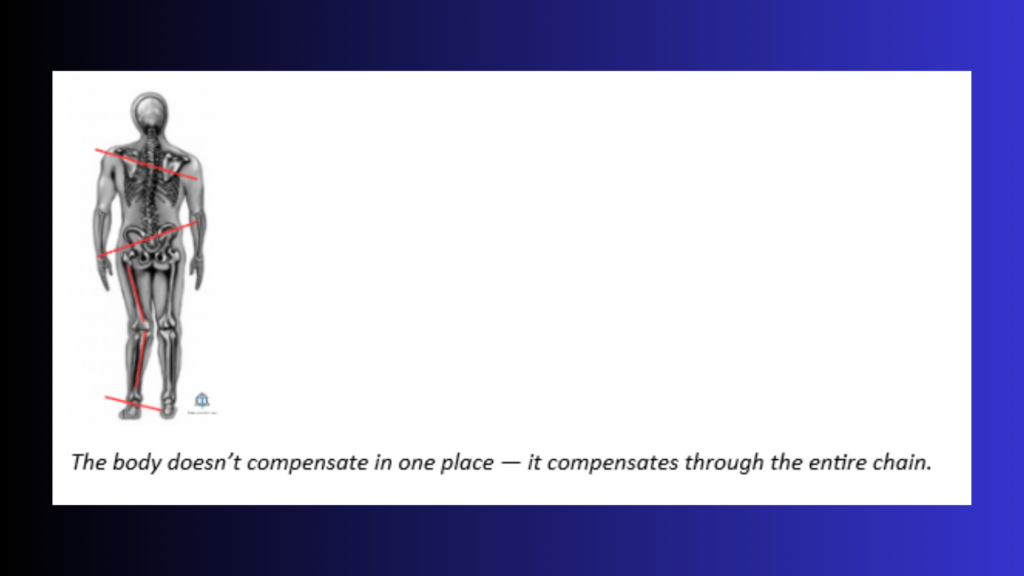
The body works the same way.
If movement is inefficient or misaligned, adding more load, intensity, or volume doesn’t fix the issue — it reinforces it.
The body doesn’t compensate in one place — it compensates through the entire chain.
Because real progress isn’t just about doing more.
It’s about doing what your body is actually prepared for.
This is where what I call functional alignment becomes important.
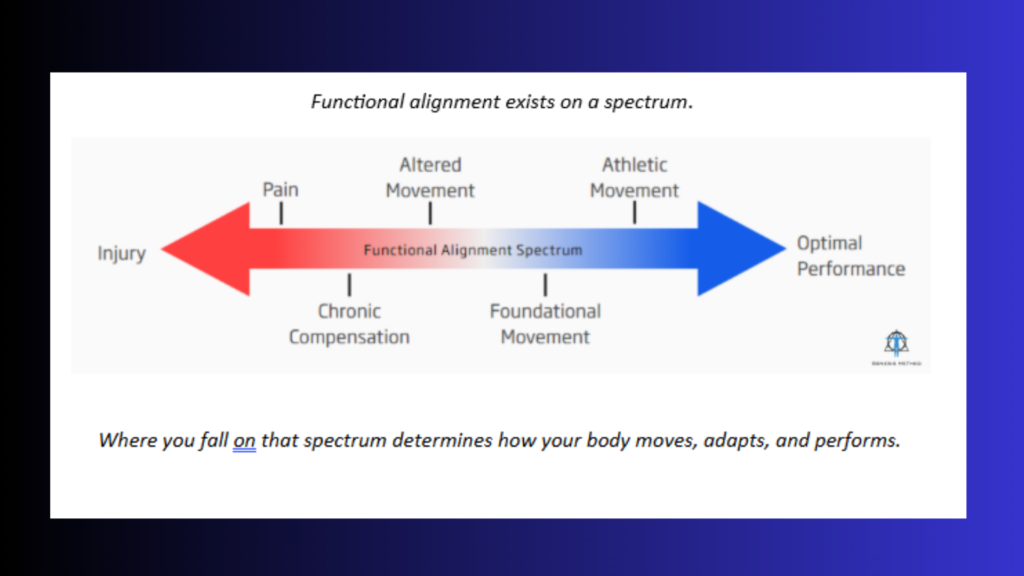
Functional alignment exists on a spectrum.
Where you fall on that spectrum determines how your body moves, adapts, and performs.
It’s not just about individual joints or isolated limitations — it’s about how different systems of the body coordinate and work together. When you’re able to measure functional alignment, you can identify how those systems interact, where breakdowns occur, and how those breakdowns influence performance, increase injury risk, and impact movement as a whole.
When that coordination is off, performance can still exist — but it’s often built on compensation.
I see this frequently with athletes.
They can be strong, fast, and highly skilled, yet still operate with poor functional alignment. And while that may not show up immediately, it often limits long-term development and increases wear and tear over time.
When functional alignment is improved, everything becomes more efficient.
Movement becomes cleaner.
Force transfers more effectively.
Progress becomes more consistent.
And most importantly, the body is better equipped to handle the demands placed on it.
From Assessment to Action
Understanding that alignment matters is one thing.
Knowing how to measure and apply it is what actually drives results.
Not all assessments are created equal.
Most people are familiar with basic testing — strength numbers, flexibility checks, or general movement screens. These can provide useful information, but they often only show what the body can do — not why it moves the way it does or how that movement holds up under real-world conditions.
A more complete approach looks deeper.
It considers:
- How joints move actively and under control
- How stability and mobility are balanced
- How different subsystems of the body coordinate together
- Where compensations are occurring within the movement chain
This is where that concept of functional alignment is applied.
Functional alignment allows us to measure how efficiently the body is organized and how well its systems are working together. Instead of looking at isolated pieces, it provides a clearer picture of how the body functions as a whole.
From there, programming becomes specific — exercises are no longer selected based on trends or generalized routines, but on what the individual body actually needs.
For example, it’s common to see individuals experience knee discomfort during training. However, assessment often reveals the issue isn’t at the knee itself, but in how the hips, pelvis, or ankles are controlling movement. When those underlying imbalances are addressed, the discomfort typically resolves and movement becomes more efficient, stable, and sustainable.
At The Genesis Method, this process is structured.
Progression is built through levels of challenge, allowing individuals to develop foundational control before advancing into higher levels of strength, performance, and complexity.
Because real progress doesn’t come from doing more.
It comes from doing what’s appropriate — at the right time, for the right body.
Supporting the System
While movement and programming form the foundation, recovery and cellular support also play a role in long-term performance and longevity.
Non-invasive stem cell activation patches are designed to support the body’s natural repair processes by stimulating internal signaling pathways associated with recovery, circulation, and tissue maintenance — without introducing substances into the body.
This means there are no interactions with medications, supplements, or existing conditions.
When combined with intelligent training and proper assessment, this creates a more complete approach — one that supports not just performance, but long-term function.
Train Smarter, Not Just Harder
Most people don’t need more effort.
They need better direction.
Without understanding how the body moves and compensates, it’s easy to waste time, reinforce imbalances, and limit long-term progress.
But with the right assessment and a structured approach, progress becomes more efficient, more sustainable, and more predictable.
If you’re ready to take a more personalized and strategic approach to your training and movement, The Genesis Method offers assessments and programs designed to help you move better, perform better, and build long-term resilience.
Schedule an Assessment
The Genesis Method
Houston, TX
832-743-2888
Nick@genesismethod.net
www.genesismethod.net