


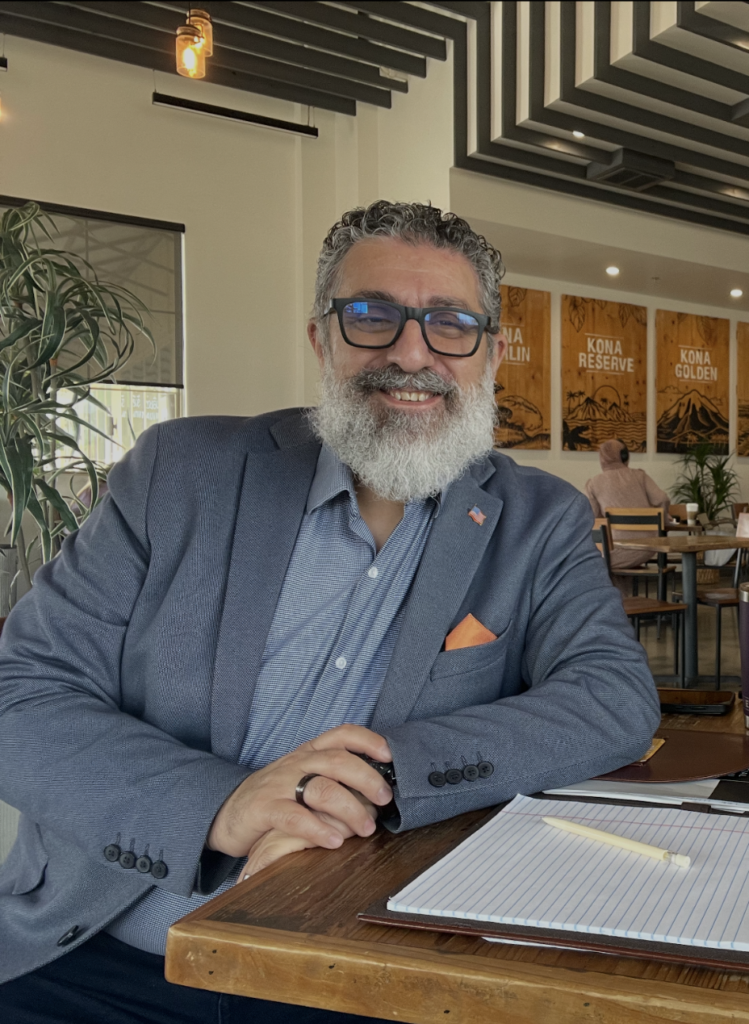
100 HOUSTON VOICES · FALL 2026
Watch Romeo’s story

There are inconveniences we complain about because they are part of everyday life in Houston.
Traffic certainly qualifies.
But Romeo Chaer sees Houston traffic differently.
When he hears people complain about sitting in traffic, his mind can travel thousands of miles away and years into the past, to Lebanon, where being stuck on a roadway once meant something entirely different.
Romeo remembers sitting in traffic while bombs fell from the sky.
Survival, he said, sometimes came down to luck.
Today, when he sits in Houston traffic, there are no bombs falling around him. And that simple difference has become another reminder of something Romeo has learned repeatedly throughout his life:
Perspective can change everything.
A Life Shaped Early
Romeo was born in Lebanon, the sixth child in his family.
He describes himself as an abortion survivor and says one of the defining events of his childhood happened when he was just three years old, when he lost an eye.
It was an injury that would affect far more than his physical appearance.
“That scar that happened to me just crafted me in the way I am today,” he said.
Growing up with that experience brought challenges throughout his childhood and teenage years, but Romeo continued forward.
He eventually completed university, becoming the first person in his family to do so.
Then came another chapter.
He met his wife, Elsie.
Their first son, Carl, was born in 2005.
A year later, war returned to Lebanon.
After more than a decade of relative peace, Romeo watched bridges destroyed and the country once again become engulfed in violence.
This time, he was no longer experiencing war only as a young man.
He was a father.
And something changed.
Romeo knew he did not want his children growing up surviving the same kind of war he had survived.
He and Elsie began the long process of leaving Lebanon.
It would take 14 years before they were finally able to move to the United States.
Their American story began in Maine before eventually leading them to Katy, Texas.
Houston became home.
And Romeo eventually became a United States citizen.
The Conversations We Don’t Know Matter
Some of Romeo’s most important moments have not happened on a stage or inside a classroom.
They have happened in conversations.
Romeo says people have always had a tendency to open up to him.
Sometimes they even stop in the middle of a conversation and ask themselves why they are sharing so much.
For years, Romeo did not fully understand the impact those conversations could have.
Then one person told him.
Romeo had developed a friendship online with someone living in another country. Through their conversations, Romeo simply created a space where the man felt comfortable talking.
Romeo did not know what was happening behind the scenes.
Years later, that friend told him that he had been preparing to take his own life.
The conversations with Romeo helped change that decision.
For Romeo, the experience revealed something important about the gift of simply being present for another human being.
Sometimes we influence someone’s life without ever realizing it.
That realization also helped shape Romeo’s future.
As a certified life coach, he initially worked with people one-on-one. But eventually he began thinking about how he could reach more people.
Writing became part of the answer.
Speaking became another.
His mission began taking shape around a central idea:
A person does not have to remain defined by a scar, a challenge or the hardest thing that has happened to them.
Finding the Light
When asked what opportunity he is looking for today, Romeo didn’t talk first about money or business.
He talked about a stage.
He wants opportunities to stand in front of people and tell them that moving forward is possible.
Because there were seasons in his own life when nobody told him that.
When he was experiencing hardship, Romeo said no one showed him what came next or assured him that there could be light beyond what he was experiencing.
Now he wants to become that voice for someone else.
He wants people going through difficult seasons to understand that the light they are searching for is not imaginary.
It can be reached.
The Woman Beside the Story
When Romeo was asked whose Houston story deserved to be told, he did not hesitate.
His wife, Elsie.
Romeo describes her as extraordinarily supportive and credits her with carrying an enormous amount of responsibility as their family worked to build a life in the United States.
She endured the pressures of moving a family from one country to another while continuing to support Romeo and their children.
Today, she works as a travel nurse and is also opening her own business.
Romeo may be the author and speaker in the family, but when asked who deserves the spotlight, he quickly turns it toward her.
Her strength, he believes, is part of his story too.
Seeing Houston Through Different Eyes
Romeo has lived in the Houston area for more than three years.
And he has developed an affection for his adopted city.
He likes the energy of Houston.
He likes the people.
He especially likes the food.
As a Lebanese immigrant, he was surprised by how much Lebanese food he could find throughout the Houston area, something he says was not nearly as available in other places he had lived.
He has even started creating his own map of places to visit and foods to try.
Then there is the traffic.
Romeo laughs when he describes it as something Houston actually does well.
To someone accustomed to driving in places where lanes and roadways can be far less orderly, Houston traffic feels surprisingly organized.
But there is a deeper reason he refuses to complain too much about it.
He remembers another kind of traffic.
Traffic where bombs could begin falling.
So sitting safely in a Houston car, even while barely moving, carries a completely different meaning.
For Romeo, inconvenience can still contain gratitude.
What the Challenges Gave Him
Romeo has spent much of his life discovering that the events we initially wish had never happened can sometimes shape the people we eventually become.
He doesn’t pretend difficult experiences are easy.
Instead, he believes they can become material for growth.
The loss of his eye.
War.
Immigration.
Starting over.
Family responsibility.
Each became part of him.
Today he sees those experiences reflected in the different roles he carries: speaker, author, husband, father and coach.
Life, Romeo believes, continually pushes human beings toward growth.
Sometimes people resist it.
Sometimes they complain through it.
Sometimes they do not recognize what is happening until much later.
But looking backward, Romeo can now see a pattern.
The challenges were changing him.
The Next Chapter
Romeo is now turning those lessons into his next body of work.
He is developing a resilient leadership training program for leaders and teams, expected to launch in early 2027. The program will introduce a framework organizations can use when navigating difficult or critical situations.
He has also completed a new book titled The Divine Recipe.
The book explores human transformation through the process of winemaking, following the journey from the vine to the bottle and comparing that process with the way people themselves are developed and transformed.
At the time of our conversation, Romeo was awaiting endorsements for the book and anticipated releasing it before the end of the year.
For someone whose life has contained more than one chapter he could have allowed to define him, perhaps that transformation is an appropriate subject.
Romeo’s story is not simply about surviving difficult things.
It is about allowing those experiences to shape something useful.
A conversation.
A book.
A stage.
A message.
And maybe, somewhere along the way, a person who needs to hear that their hardest chapter does not have to be their last.
Romeo Chaer was interviewed as part of Houston City Beat’s 100 Houston Voices, a storytelling project capturing the experiences, perspectives and journeys of people throughout the Houston community.

