
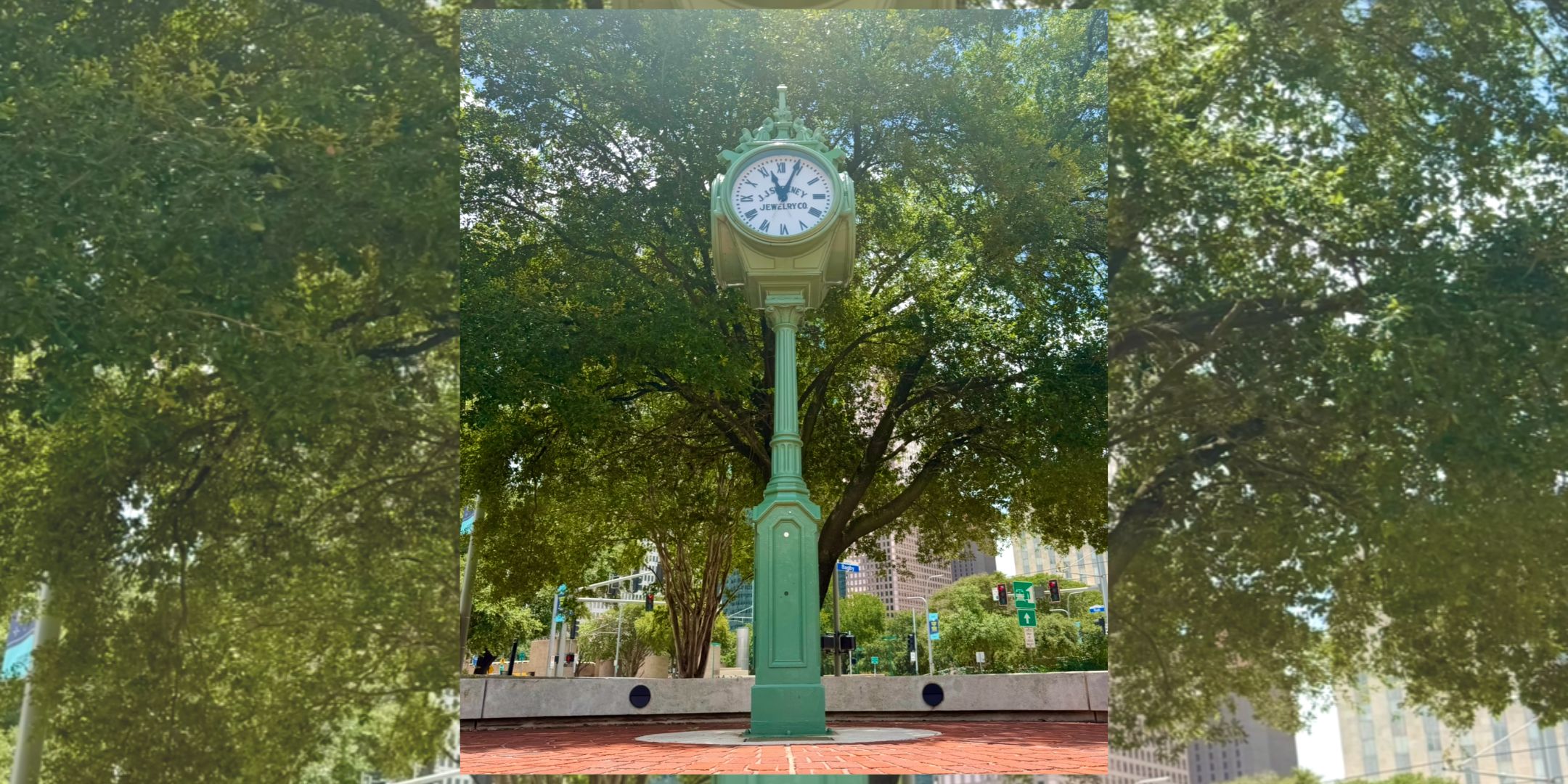
Thousands of people pass through Downtown Houston every day, hurrying between offices, restaurants, theaters, and sporting events. Yet tucked quietly into a small triangular park at the intersection of Bagby, Rusk, and Capitol Streets stands one of the city’s oldest surviving landmarks, often overlooked by those walking just a few feet away.
The Sweeney Clock has been keeping time in Houston for more than a century.
Standing nearly 15 feet tall, the Victorian-style cast-iron street clock has witnessed Houston transform from a city of horse-drawn wagons into one of America’s largest metropolitan areas. It has survived devastating floods, powerful hurricanes, changing skylines, and generations of Houstonians, all while continuing to mark the passage of time.
Originally crafted in Boston by the renowned clockmaker E. Howard & Co., the clock arrived in Houston in 1908. It was installed outside the J.J. Sweeney & Co. jewelry store at Main Street and Prairie Avenue, where it quickly became both a landmark and a gathering place.
In those early years, the Sweeney Clock served a purpose beyond telling time. Customers arriving by horse and carriage often used it as a convenient hitching post while they visited nearby businesses, making the clock a familiar part of everyday downtown life.
When the jewelry store relocated in 1929, owner John Jasper Sweeney donated the clock to the City of Houston. It found a new home at the city’s Farmer’s Market, continuing to serve the public through another era of Houston’s growth.
But as automobiles replaced horses and the city modernized, the historic clock slowly faded from public view.
Eventually, it was placed into storage and came dangerously close to disappearing forever.
In 1961, the Sweeney Clock narrowly escaped being sold as surplus property. Several years later, Houston City Council member Lee McLemore intervened once again to save it from the scrap heap. Thanks to the efforts of local preservationists and the Colonial Dames of America, the clock received a new lease on life.
The civic organization funded a $2,000 restoration and constructed the clock’s distinctive base using more than 11,000 antique bricks salvaged from historic Navigation Street. In 1971, the restored timepiece was installed at its current location in what is now known as Sweeney Triangle, just steps from Bayou Place, the Hobby Center for the Performing Arts, and Tranquillity Park.
The clock underwent another restoration in 2002, ensuring that future generations could continue to enjoy this remarkable piece of Houston history.
Today, the Sweeney Clock represents much more than an antique timepiece.
A fully restored Victorian street clock like this can command values approaching $150,000 on the antique market, with the ornate cast-iron structure and historic brick foundation each representing significant pieces of craftsmanship in their own right. More importantly, it remains a tangible connection to a Houston that many residents never had the opportunity to experience.

Maintained by the City of Houston, the Sweeney Clock continues to stand quietly in the Theater District, reminding visitors that while skyscrapers rise and neighborhoods evolve, some pieces of history deserve to remain exactly where they belong.
The next time you’re exploring Downtown Houston, pause for a moment at Sweeney Triangle. Look up at the hands that have marked more than a century of Houston history and consider just how close this remarkable landmark came to being lost forever.
Sometimes the city’s greatest stories aren’t hidden behind museum walls. They’re standing in plain sight, simply waiting for someone to stop and notice.