
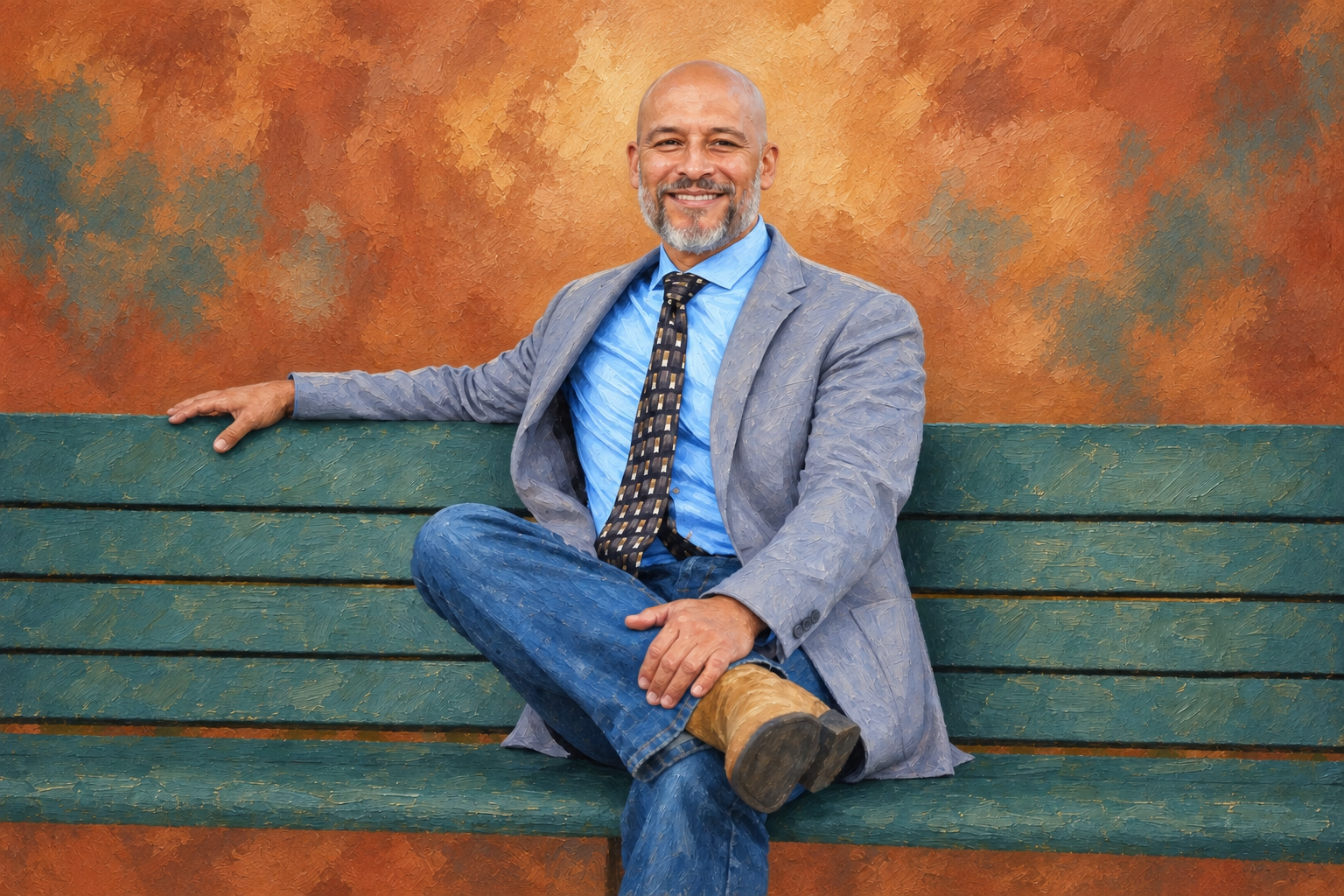
For Tony Aranda, service has rarely been about holding a title.
Long before his path brought him to the Houston area, before ministry, fatherhood and a run for public office, service was something he learned through family and eventually practiced for more than two decades in the United States Marine Corps.
But the roots of Aranda's story stretch even further back, into a Hispanic family shaped by migration, agricultural work, sacrifice and a father determined to keep his children together.
Aranda was born in Bradenton, Florida. His father was born in Brownsville, Texas, and worked as a migrant farmworker, following agricultural work from Texas through other parts of the country.
Eventually, the family made its way to Wisconsin.
For Aranda, one of the most important figures in that story was his father.
When his parents separated while Aranda was very young, his father assumed responsibility for raising him. Aranda's sister initially lived in California with their biological mother, but his father later obtained custody of her as well.
"My dad was the lynchpin, if you will, to keep us connected," Aranda recalled.
That example stayed with him.
His father also challenged him not to build his life around a paycheck alone.
As Aranda approached adulthood, his father told him that he did not want his son settling into a job simply because the money seemed good enough. If Aranda felt called toward something larger, including military service, his father encouraged him to pursue it.
At 17, Aranda enlisted in the Marine Corps.
By 18, he was headed to boot camp in San Diego.
What followed was a 22-year military career that took him through artillery, Marine Security Guard duty and aviation. For the final 15 years of his career, he served as a helicopter crew chief.
The Marine Corps also took him far beyond the world he had known growing up.
During embassy assignments, Aranda lived in Cuba and Colombia. Those experiences, he said, changed the way he viewed the United States.
Living in Cuba gave him firsthand exposure to life in a communist country. Colombia exposed him to another reality, one in which kidnapping, bombings and political violence were part of the fears ordinary families could encounter.
The experiences strengthened a patriotism that had been present since childhood.
They also deepened his understanding of what it means to serve people he may never personally know.
As a helicopter crew chief, Aranda described the Marines and service members on the ground as his "customers." His responsibility was not about recognition. It was about making sure other people could accomplish their mission and come home.
Some, tragically, did not.
Aranda remembers transporting fallen service members whose names he may never have known.
That idea of serving people without needing recognition would become a thread running through the next chapter of his life.
A New Mission Brings Him to Houston
In 2019, Aranda retired from the Marine Corps.
He initially had two very different ideas about what might come next.
One was education. Aranda wanted to attend a Christian university and complete his degree.
The other involved diving.
A certified diver, Aranda hoped to become a safety diver for NASA.
Houston unexpectedly offered the possibility of pursuing both.
After learning about Houston Baptist University, now Houston Christian University, Aranda and his family made their way to the Houston area.
The NASA opportunity did not materialize.
College did.
Aranda enrolled at Houston Baptist University and ultimately earned a bachelor's degree in political science with a minor in biblical studies. His educational background and Marine Corps service are also reflected in his current public biography.
What initially looked like one closed door became the beginning of a much different life in Houston.
Around the same period, his family was growing.
Aranda and his wife, Rebecca, were raising their young son while preparing for the birth of their second child. When Rebecca experienced complications during the pregnancy, Aranda decided that being present for his family needed to take priority.
After graduation, he stayed home to help.
It was another form of service, quieter than the Marine Corps but no less important to him.
Faith Becomes Part of His Houston Story
The Arandas eventually joined a new church.
When church leaders learned that Tony had studied the Bible at Houston Baptist University, they asked whether he would consider working with the church's senior ministry.
There was one condition: he needed to become a member.
So the family joined.
Aranda began serving with the senior ministry and continues to be involved in church service. About a year later, he was selected to serve as a deacon, a responsibility he says he does not take lightly.
Faith had been present in his life long before Houston, however.
One of his earliest connections came through the woman Aranda calls his mother, the woman who helped raise him during childhood.
She died when he was 12.
Of all the possessions she left behind, two mattered most to him: her crucifix and her Bible.
He carried both with him during military deployments.
For years, he rarely opened the Bible.
But he carried it anyway.
Only during the final years of his military career did he begin engaging more deeply with the faith represented by the book that had traveled around the world with him.
Today, that faith sits at the center of how Aranda describes his responsibilities as a husband and father.
He frequently returns to the biblical declaration from Joshua: "As for me and my house, we will serve the Lord."
For Aranda, the verse represents accountability.
He doesn't want his personal preferences to become the ultimate standard for his family. He wants his wife and children to be able to measure his decisions against something beyond himself.
His aspirations for fatherhood are closely connected to the example he received from his own father.
He wants his children to one day remember a father who loved them, led responsibly and left behind a legacy worthy of carrying forward.
The Hispanic Family Story Behind the Uniform
Aranda's story is also part of the much larger Hispanic story woven throughout Houston and Texas.
It is the story of a father from Brownsville working agricultural fields and moving wherever work could be found.
It is a family moving across states.
It is a child raised between cultures and circumstances, carrying forward lessons about responsibility, work and family.
It is also a distinctly American Hispanic story that refuses to fit neatly inside a single box.
Aranda's path runs through South Texas roots, Florida, Wisconsin, military bases, American embassies, Cuba, Colombia and eventually Houston.
Through it all, he says the constant has been service.
That word has meant different things during different seasons.
Sometimes it meant serving aboard a military aircraft.
Sometimes it meant coming home because his wife needed him.
Sometimes it meant sitting with senior members of a church.
Sometimes it meant raising children.
And now it has led him toward civic involvement.
From Military Service to Public Service
Aranda did not initially set out to become a candidate.
After leaving the military and completing school, he spent time volunteering and working on a ranch.
Then came a text message he initially assumed had been sent to the wrong person.
Would he consider running for Fort Bend County Commissioner, Precinct 2?
He laughed.
Then he learned the question was serious.
Aranda talked with Rebecca and prayed about the decision.
Eventually, he said, one idea settled heavily on him:
"It's not about you. It will never be about you."
That thought connected public service to something he already understood.
For 22 years, his profession had revolved around serving other people.
He began looking at local government through the same lens.
Rather than describing the position simply as a job, Aranda talks about it as a responsibility involving people's money, neighborhoods and everyday lives.
Aranda is currently the Republican candidate for Fort Bend County Commissioner Precinct 2 in the November 3, 2026 general election. Public election information and his campaign materials confirm his candidacy.
His political beliefs will ultimately be evaluated by voters.
But the journey that brought him to this moment began long before politics.
It began with a migrant-working father from Brownsville.
With a Bible and crucifix belonging to the mother who raised him.
With a teenager choosing the Marine Corps.
With 22 years of service.
With a young family moving to Houston because one man thought perhaps he could dive for NASA and attend a Christian university at the same time.
The NASA job never happened.
Houston did.
And for Tony Aranda, what began as another stop along an unpredictable journey became home, a place where his Hispanic heritage, military experience, family life, faith and commitment to service began converging into something new.
His story is one of many reminders that Houston’s Hispanic community is not one story.
It is thousands of journeys, carried across borders, states, generations and professions.
Aranda's happens to have traveled through farm fields, military helicopters and distant countries before finally arriving here.