
Ten portraits from UTHealth Houston highlight the people, support systems, and possibilities at the heart of recovery.
Adapted by Lisbet Newton for Houston City Beat from reporting published by UTHealth Houston.
Shajee is working toward an associate degree. His next goal is to become a drug counselor, offering others the kind of support that helped change his own life.
For the 36-year-old, one person’s willingness to show up made a lasting difference.
“In a world of strangers, I had somebody come and advocate for me like they were family,” he said in remarks shared by UTHealth Houston.
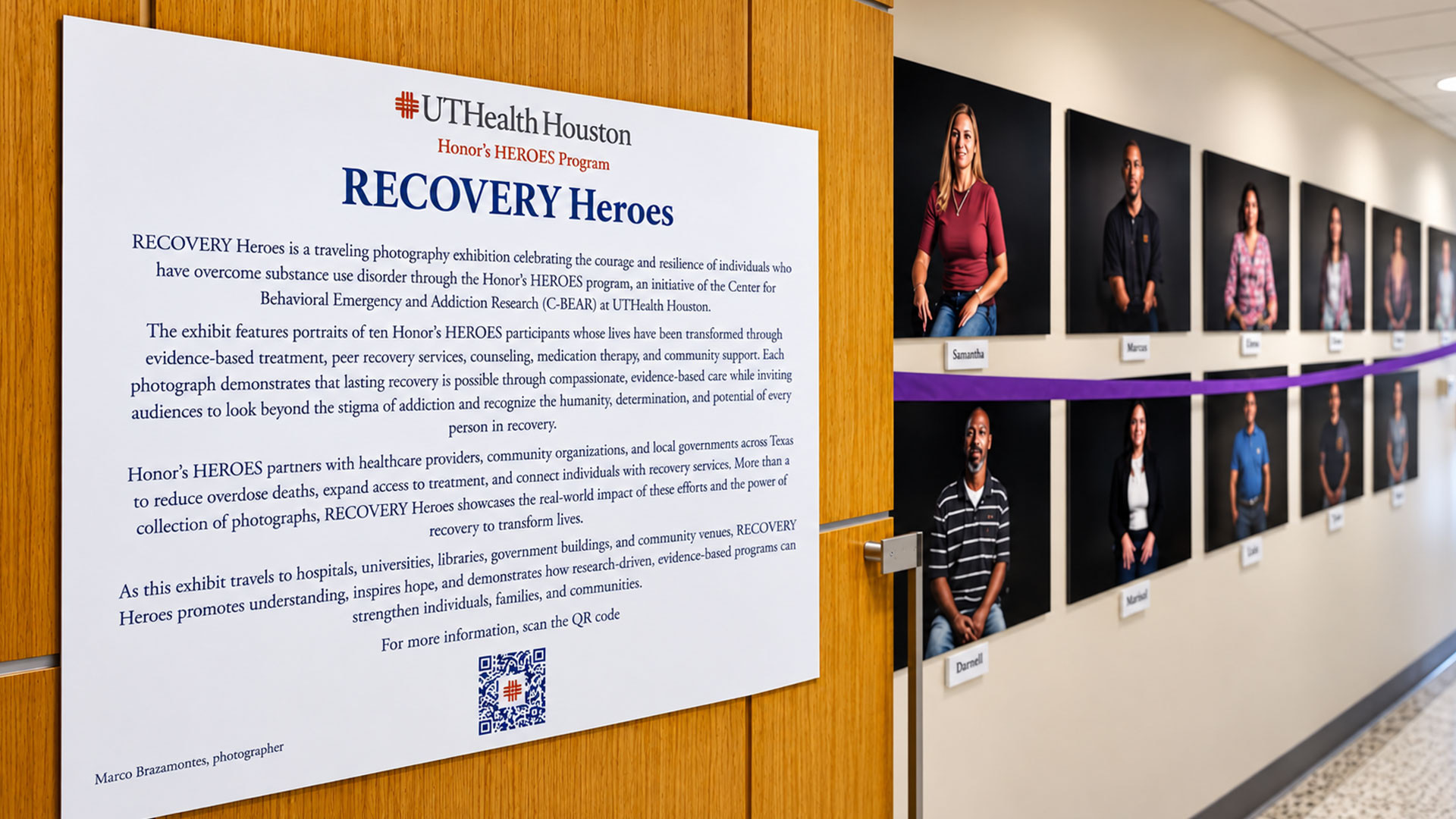
His story is one of 10 represented in RECOVERY Heroes, a traveling photography exhibition unveiled Sept. 21 at UTHealth Houston. Through portraits of people recovering from substance use disorder, the project gives Houstonians a closer look at lives too often reduced to labels or statistics.
The exhibition was created through Honor’s HEROES, an initiative of the Center for Behavioral Emergency and Addiction Research at UTHealth Houston’s McWilliams School of Biomedical Informatics. Organizers plan to bring the portraits to hospitals, universities, libraries, government buildings, and other community spaces to encourage understanding and challenge the stigma surrounding addiction.
The people behind the portraits
Among the participants is Emily, 41, who joined the program in 2020 and will mark six years of recovery on Oct. 11.
“They helped me with their four pillars: health, home, community, and purpose. I wish everywhere had a program like this,” she said.
Those four areas reflect how much rebuilding a life can involve. Treatment is part of the work, alongside finding stability, connection, and a reason to keep moving forward.
For Shajee, that support included recovery support peer specialist “Coach” Crystal Walsh. He credited her advocacy at a vulnerable point in his life as an important part of his progress.
Today, his educational plans and hope of becoming a counselor give that experience a new direction. His portrait joins Emily’s and eight others in an exhibition that asks viewers to recognize the person and the possibilities in front of them.
A photography assignment with a bigger purpose
RECOVERY Heroes began as a smaller project.
Marco Bracamontes, a senior communications specialist at the center, photographed the 10 participants for a presentation about recovery. As he worked, he saw an opportunity to create portraits that could tell a broader story.
He wanted the photographs to remain authentic.
“My goal was to capture and to print the colors, the faces, and the smiles of these wonderful people,” Bracamontes said.
James Langabeer, co-founder of Honor’s HEROES, emphasized that recovery involves difficult work, with ups and downs, and that the participants come from many different backgrounds and communities.
Houston roots and a family’s legacy
The program began in 2017 as the Houston Emergency Opioid Engagement System, connecting people with opioid use disorder to treatment and recovery services.
Its work includes medical and behavioral healthcare, peer recovery support, care navigation, overdose prevention, and community outreach. Partnerships with healthcare providers, first responders, local governments, and community organizations help connect people with that support.
In 2025, a gift from Sherry and Barry Wallace helped support the program’s future. Their daughter, Honor Nicole Wallace, died in 2022 at age 25 after struggling with substance use.
The family’s commitment included immediate funding and an endowment to sustain the work. The program was renamed Honor Nicole Wallace HEROES in recognition of their gift.
RECOVERY Heroes carries that mission into public spaces, where a portrait can open a conversation. For Houston, the exhibition offers a chance to learn about neighbors whose lives include recovery, education, family, and new ambitions.
Shajee’s hope of becoming a counselor is one of those ambitions. The support he received may one day become the support he gives someone else.
